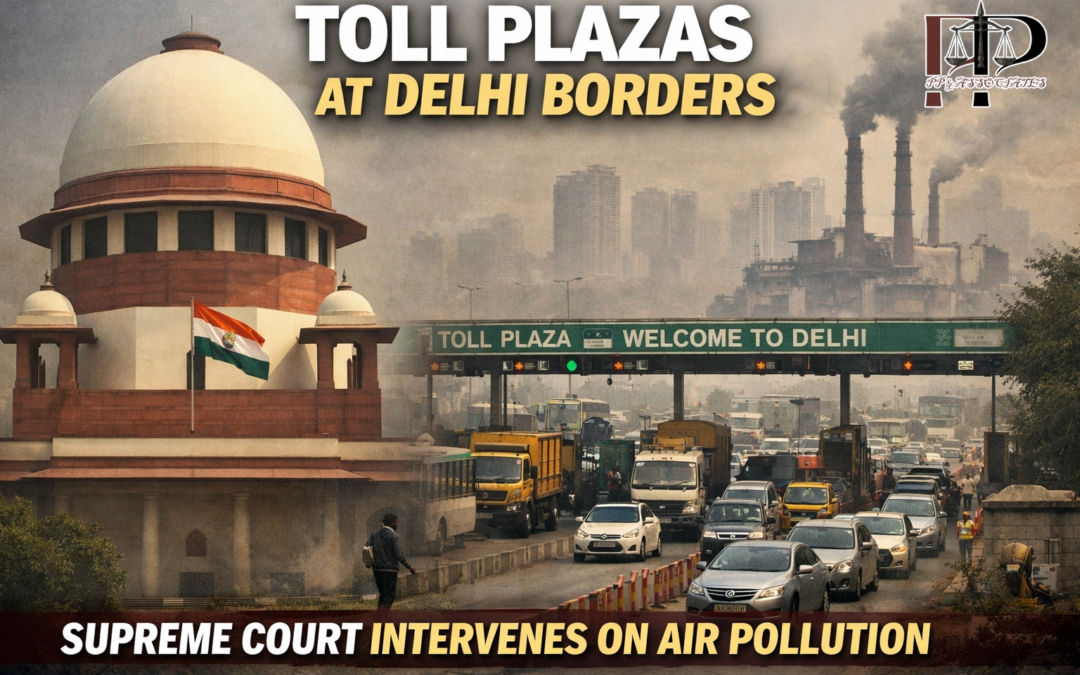
Supreme Court Asks NHAI & MCD to Consider Shifting or Closing 9 Toll Plazas at Delhi Borders to Tackle Air Pollution
Introduction
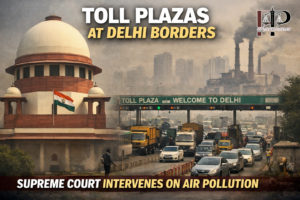
Delhi’s worsening air quality has once again drawn the attention of the Supreme Court of India. Amid rising concerns over public health and environmental degradation, the Court has directed key authorities to explore immediate structural measures to reduce vehicular pollution. One such significant step is the direction to consider shifting or temporarily closing nine toll plazas located at Delhi’s border points, which are believed to be major contributors to traffic congestion and emissions.
Supreme Court’s Observations on Air Pollution
While hearing matters related to air pollution in Delhi and the National Capital Region (NCR), the Supreme Court expressed serious concern over the recurring deterioration in air quality during the winter months. The Court noted that despite multiple regulatory measures, vehicular congestion at entry points continues to worsen pollution levels.
The bench emphasized that repeated emergency steps, such as restrictions on vehicle movement and temporary closures of institutions, cannot be the only solution. Instead, authorities must focus on long-term and practical administrative changes that can reduce pollution at its source.
Direction to NHAI and MCD
In this context, the Supreme Court asked the Municipal Corporation of Delhi (MCD) and the National Highways Authority of India (NHAI) to evaluate the feasibility of either:
- Temporarily closing nine toll plazas located at Delhi’s borders, or
- Shifting these toll plazas to locations away from city entry points
The Court also questioned why toll collection could not be suspended for a limited period during peak pollution months, especially when traffic congestion caused by toll booths leads to increased idling of vehicles and higher emissions.
Role of Toll Plazas in Vehicular Pollution
Toll plazas at Delhi’s borders are known to cause long traffic queues, particularly for commercial and heavy vehicles entering the city. These bottlenecks result in:
- Increased idling time of vehicles
- Higher emissions of particulate matter and harmful gases
- Slower traffic movement and fuel wastage
The Court acknowledged that reducing congestion at these entry points could have a direct and measurable impact on improving air quality.
Time-Bound Responsibility on Authorities
The Supreme Court placed a clear responsibility on the MCD to decide within a short timeframe on whether toll plazas can be temporarily shut. At the same time, NHAI was asked to examine alternative arrangements, including relocation of toll booths, while ensuring that revenue sharing and administrative coordination are maintained.
This reflects the Court’s insistence on accountability and urgency, especially when public health is at stake.
Legal and Policy Significance
This direction highlights the judiciary’s increasing role in environmental governance. It reinforces the principle that when executive action is insufficient or delayed, constitutional courts can step in to protect citizens’ fundamental rights, including the right to life and a clean environment.
The case also raises important questions regarding:
- Inter-agency coordination between municipal bodies and highway authorities
- Balancing revenue considerations with environmental and health concerns
- The need for sustainable urban traffic management policies
Conclusion
The Supreme Court’s suggestion to shift or close toll plazas at Delhi’s borders marks a significant move towards addressing the root causes of urban air pollution. Rather than relying solely on short-term restrictions, the focus is now on structural reforms that can deliver lasting results.
For policymakers, administrators, and legal professionals, this development underscores the importance of proactive governance in environmental matters. At PP & Associates, we continue to monitor such landmark judicial interventions that shape environmental law and public policy in India.