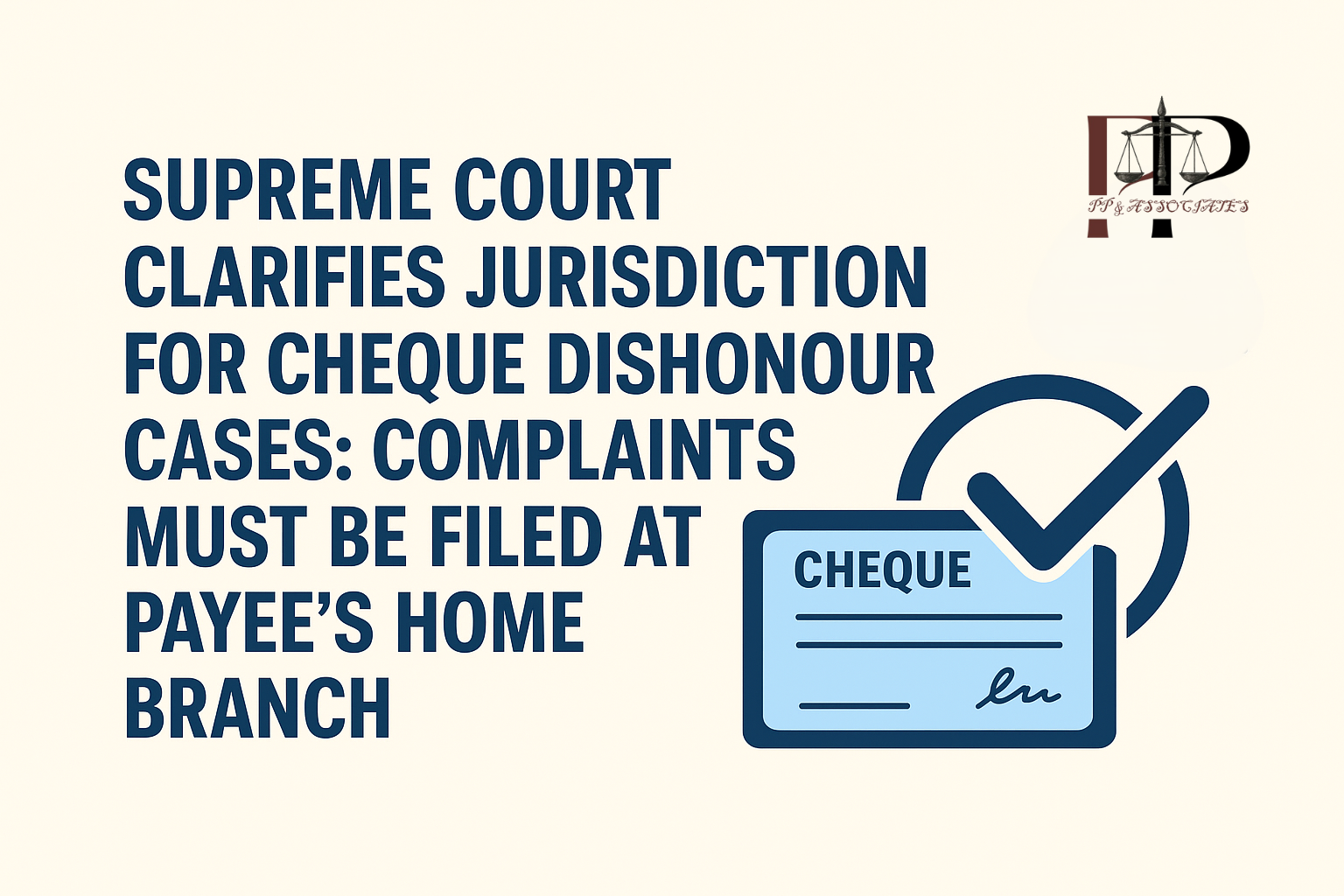
Supreme Court Clarifies Jurisdiction for Cheque Dishonour Cases: Complaints Must Be Filed at Payee’s Home Branch
The Supreme Court of India has recently delivered a significant ruling that reshapes how cheque-dishonour cases under Section 138 of the Negotiable Instruments Act (NI Act) should be filed. The Court has clarified that complaints relating to dishonour of “account-payee” cheques must be instituted only in the court having jurisdiction over the branch where the payee maintains his or her bank account.
This decision resolves longstanding confusion about whether cases can be filed at the branch where the cheque was deposited, even when it is dropped at a different branch for convenience.
Why This Judgment Matters
For years, litigants and lawyers have faced uncertainty about the correct jurisdiction for filing cheque-bounce cases. Many payees deposited cheques at branches located in different cities, often leading to complaints being filed at those locations. This resulted in forum shopping, procedural objections, and delays.
The Supreme Court’s ruling brings uniformity, clarity, and fairness by confirming that the payee’s home branch—not the place of physical deposit—is the sole valid point of jurisdiction.
What the Supreme Court Held
The Court interpreted Section 142(2)(a) of the NI Act (as amended in 2015), which governs territorial jurisdiction for cheque-dishonour complaints. The key points of the ruling are:
1. Jurisdiction lies only at the payee’s home branch
- The “home branch” refers to the branch where the payee holds the operative bank account into which the cheque was meant to be credited.
2. Place of deposit is irrelevant
- Even if the cheque is deposited at another branch of the same bank, the law deems it to have been delivered for collection at the home branch.
3. Earlier conflicting interpretations stand clarified
- The ruling overrides previous interpretations that allowed complaints to be filed at the location of the deposit branch.
Legal Basis Explained
Section 142(2)(a) NI Act states that when a cheque is “delivered for collection through an account,” the complaint must be filed where the payee’s bank branch is situated.
An Explanation added by the 2015 Amendment further clarifies that a cheque deposited at any other branch (including ATMs and drop boxes) is legally considered to have been delivered at the payee’s own branch.
Thus, the relevant jurisdiction is tied strictly to the payee’s bank branch, eliminating any ambiguity.
Impact on Litigants and Practitioners
For Payees (Complainants)
- Before filing a complaint, confirm the exact location of the bank branch where your account is maintained.
- Filing at the wrong location now risks dismissal on jurisdictional grounds.
- Banks can provide account certificates or statements to support the jurisdiction.
For Drawers (Accused Persons)
- You may raise preliminary objections if the complaint has been filed in an incorrect jurisdiction.
- Jurisdictional challenges are now stronger and more clear-cut.
For Lawyers
- Ensure strict compliance with the jurisdictional requirements to avoid delays or transfer applications.
- Inform clients upfront about the correct forum to prevent unnecessary litigation expense.
Implications for Pending Cases
The Supreme Court has indicated that while some ongoing cases may continue due to advanced stages of trial, this does not alter the general rule. All future complaints must comply with the clarified jurisdictional mandate.
Courts may examine pending matters and redirect or dismiss cases wrongly filed in courts lacking jurisdiction.
Practical Checklist for Filing Cheque-Bounce Cases
✔️ Identify the payee’s home branch where the account is held
✔️ Prepare documents showing that the cheque was intended for that account
✔️ Draft and issue a valid legal notice under Section 138
✔️ File the complaint only before the court having territorial jurisdiction over the home branch
✔️ Avoid filing at the deposit location if it differs
Why This Ruling Strengthens the NI Act Framework
By eliminating forum shopping and ensuring predictable jurisdiction, the Supreme Court has reinforced the purpose of the NI Act: speedy, fair, and efficient disposal of cheque-dishonour disputes. The ruling protects both payees and drawers by making the process more transparent and consistent across India.
Conclusion
The Supreme Court’s clarification is a major step toward ensuring uniformity in cheque-dishonour litigation. The decision underscores that the payee’s home branch is the only legally valid place to initiate proceedings under Section 138. For individuals and businesses alike, this ruling should guide all future actions involving dishonoured cheques.
If you require legal assistance in filing or defending a cheque-bounce case, PP & Associates is equipped to guide you through every step of the process.