
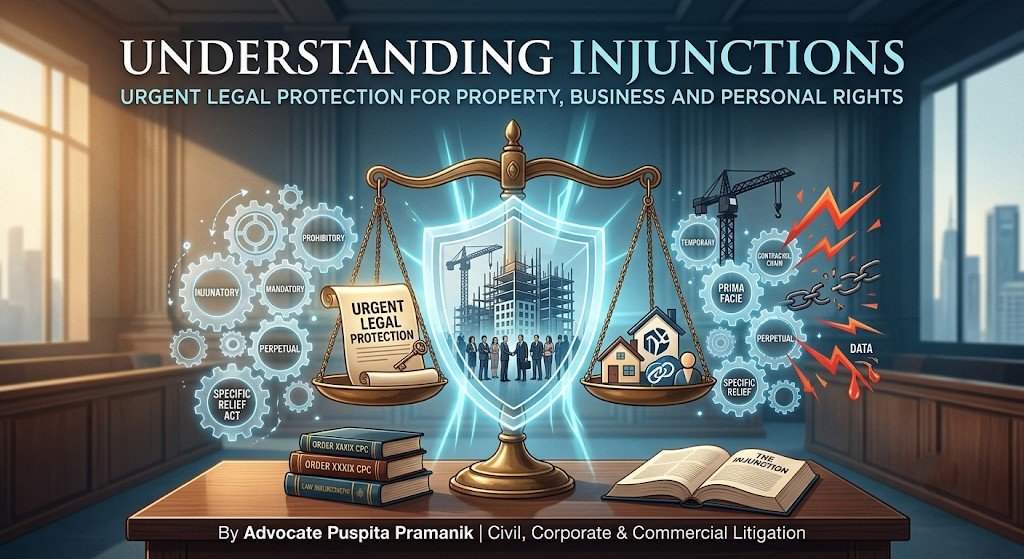
Understanding injunctions: urgent legal protection for property, business and personal rights
By Advocate Puspita Pramanik | Civil, Corporate & Commercial Litigation
Your neighbour starts building over disputed land. A developer threatens to sell property involved in a lawsuit. A former business associate plans to disclose confidential information. What if the damage is done before the court delivers its final judgment?
Indian law offers a preventive remedy: an injunction. It is a court order that may stop a threatened act or, where justified, require corrective action. It is not automatic, and it is not a shortcut to winning a case.
FOUR FORMS OF PROTECTION — AND WHEN THEY MATTER
Prohibitory injunction: Stops an act—for example, further unauthorised construction or interference with possession.
Mandatory injunction: Requires an act—for example, removal of an unlawful obstruction (Specific Relief Act, s. 39).
Temporary injunction: Protects rights while proceedings continue; it may last for a set period or until further orders.
Perpetual injunction: Provides final protection by decree after the case has been decided on its merits.
The first two describe what the order does; the latter two describe when and for how long it operates. The categories can overlap.
WHAT WILL THE COURT ASK BEFORE GRANTING URGENT RELIEF?
For a temporary injunction, the court ordinarily examines three connected questions: Is there a prima facie case (a serious right requiring trial)? Does the balance of convenience favour protection? Is there a real risk of irreparable injury that money alone would not adequately remedy? A filed lawsuit, by itself, is insufficient.
Example: Preventing imminent demolition of a disputed structure may warrant urgent consideration; a straightforward claim for money may often be addressed through other remedies. Every case depends on evidence and applicable law.
WHAT IF THE OTHER SIDE ACTS BEFORE NOTICE CAN BE SERVED?
In exceptional circumstances, a court may grant an ex parte interim injunction without first hearing the opposite party, where delay would defeat the purpose of relief. Order XXXIX Rule 3 CPC requires reasons and procedural safeguards. The affected party can seek variation or discharge under Rule 4 and may have an appellate remedy.
WHAT IF AN INJUNCTION IS IGNORED — OR WRONGLY OBTAINED?
Disobedience of an injunction under Order XXXIX Rules 1 or 2 may attract proceedings under Rule 2A, including attachment and, where legally justified, civil detention. Conversely, injunctions can be refused under Section 41 of the Specific Relief Act; compensation may be available in defined cases under Section 95 CPC. The order must be challenged lawfully, not simply disregarded.
THE PRACTICAL TAKEAWAY
Act before the harm becomes irreversible. Preserve title documents, contracts, photographs, messages, approvals and evidence of the threatened act. If an order has been passed against you, obtain its exact terms immediately and assess your options. The court protects established legal interests—not whoever reaches the courthouse first.